Translate

Showing posts with label god. Show all posts

Monday, February 3, 2014

ETERNAL FATHER STRONG TO SAVE

.
.

.
.

.
.
From Wikipedia
.
The original hymn was written in 1860 by William Whiting,
 an Anglican churchman from Winchester, Great Britain.
 Whiting grew up near the ocean on the coasts of England,
and at the age of thirty-five had felt his life spared by God
 when a violent storm nearly claimed the ship he was travelling
 on, instilling a belief in God's command over the rage and calm
 of the sea.
 As headmaster of the Winchester College Choristers' School
 some years later, he was approached by a student about to
 travel to the United States, who confided in Whiting an
 overwhelming fear of the oean voyage. Whiting shared his
 experiences of the ocean, saying he wrote the hymn to
 "anchor his faith". 
In writing it, Whiting is generally thought to have been
 inspired by Psalm 107, which describes the power and fury
 of the seas in great detail:
Some went out on the sea in ships;
 they were merchants on the mighty waters.
They saw the works of the Lord,
 his wonderful deeds in the deep.
For he spoke and stirred up a tempest
 that lifted high the waves.
They mounted up to the heavens and
 went down to the depths;
 in their peril their courage melted away.
Psalm 107: 23-26
.
.
Within a year the text appeared in the influential first edition of Hymns Ancient and Modern (HA&M) in 1861 and its circulation became widespread throughout England.
 The text was substantially revised by the compilers of that
 edition. In response Whiting continued to revise his own text,
 releasing another version in 1869 and third in 1874, the last
 one incorporating most of the suggested changes by HA&M.
Meanwhile, John B. Dykes, an Anglican clergyman, composed
 the tune "Melita" to accompany the HA&M version of 1861.
 Dykes was a well-known composer of nearly three hundred
 hymn tunes, many of which are still in use today.
 "Melita" is an archaic term for Malta, an ancient seafaring
 nation which has been a colony of the British Empire. It was
 the site of a shipwreck, mentioned in Acts of the Apostles
 (chapters 27-28), involving the Apostle Paul.
The original words of the 1861 version are:
.
Eternal Father, strong to save,
Whose arm hath bound the restless wave,
Who bidd'st the mighty ocean deep
Its own appointed limits keep;
Oh, hear us when we cry to Thee,
For those in peril on the sea!
O Christ! Whose voice the waters heard
And hushed their raging at Thy word,
Who walkedst on the foaming deep,
And calm amidst its rage didst sleep;
Oh, hear us when we cry to Thee,
For those in peril on the sea!
Most Holy Spirit! Who didst brood
Upon the chaos dark and rude,
And bid its angry tumult cease,
And give, for wild confusion, peace;
Oh, hear us when we cry to Thee,
For those in peril on the sea!
O Trinity of love and power!
Our brethren shield in danger's hour;
From rock and tempest, fire and foe,
Protect them wheresoe'er they go;
Thus evermore shall rise to Thee
Glad hymns of praise from land and sea.
.
.

.
.
Here's the song by the U.S.Navy Band & Chorus,
a very moving, very powerful version.  Video background
is simply satellite footage over the "blue planet."
.

.
.
.
.
.

Wednesday, November 14, 2012

ERRONEOUS IDEAS OF GOD

.
.
.
.
From THE URANTIA BOOK
Part I, 4, 4 
 
ERRONEOUS IDEAS OF GOD

   Religious tradition is the imperfectly preserved record of the experiences of the God-knowing men of past ages, but such records are untrustworthy as guides for religious living or as the source of true information about the Universal Father. Such ancient beliefs have been invariably altered by the fact that primitive man was a mythmaker.
 .
.
   One of the greatest sources of confusion on Urantia concerning the nature of God grows out of the failure of your sacred books clearly to distinguish between the personalities of the Paradise Trinity and between Paradise Deity and the local universe creators and administrators. During the past dispensations of partial understanding, your priests and prophets failed clearly to differentiate between Planetar Princes, System Sovereigns, Constellation Fathers, Creator Sons, Superuniverse Rulers, the Supreme Being, and the Universal Father. Many of the messages of subordinate personalities, such as Life Carriers and various orders of angels, have been, in your records, presented as coming from God himself. Urantian religious thought still confuses the associate personalities of Deity with the Universal Father himself, so that all are included under one appellation.
 .
.
   The people of Urantia continue to suffer from the influence of primitive concepts of God. The gods who go on a rampage in the storm; who shake the earth in their wrath and strike down men in their anger; who inflict their judgments of displeasure in times of famine and flood—these are the gods of primitive religion; they are not the Gods who live and rule the universes. Such concepts are a relic of the times when men supposed that the universe was under the guidance and domination of the whims of such imaginary gods. But mortal man is beginning to realize that he lives in a realm of comparative law and order as far as concerns the administrative policies and conduct of the Supreme Creators and the Supreme Controllers.
.
. 
   The barbarous idea of appeasing an angry God, of propitiating an offended Lord, of winning the favor of Deity through sacrifices and penance and even by the shedding of blood, represents a religion wholly puerile and primitive, a philosophy unworthy of an enlightened age of science and truth. Such beliefs are utterly repulsive to the celestial beings and the divine rulers who serve and reign in the universes. It is an affront to God to believe, hold, or teach that innocent blood must be shed in order to win his favor or to divert the fictitious divine wrath.

.
   The Hebrews believed that " without the shedding of blood there could be no remission of sin. " They had not found deliverance from the old and pagan idea that the Gods could not be appeased except by the sight of blood, though Moses did make a distinct advance when he forbade human sacrifices and substituted therefor, in the primitive minds of his childlike Bedouin followers, the ceremonial sacrifice of animals.
.
. 
   The bestowal of a Paradise Son on your world was inherent in the situation of closing a planetary age; it was inescapable, and it was not made necessary for the purpose of winning the favor of God. This bestowal also happened to be the final personal act of a Creator Son in the long adventure of earning the experiential sovereignty of his universe. What a travesty upon the infinite character of God! this teaching that his fatherly heart in all its austere coldness and hardness was so untouched by the misfortunes and sorrows of his creatures that his tender mercies were not forthcoming until he saw his blameless Son bleeding and dying upon the cross of Calvary!
.
. 
   But the inhabitants of Urantia are to find deliverance from these ancient errors and pagan superstitions respecting the nature of the Universal Father. The revelation of the truth about God is appearing, and the human race is destined to know the Universal Father in all that beauty of character and loveliness of attributes so magnificently portrayed by the Creator Son who sojourned on Urantia as the Son of Man and the Son of God.
.

.

Tuesday, July 19, 2011

THE MYTH OF QUETZALCOATL

.
.
Of the many gods [of the pre-Spanish era in the Americas], Quetzalcoatl stands out alone as the most warmly human, divinely inspired, and mysteriously unknown.
.
Quetzalcoatl, says Spinden, was "the greatest figure
in the ancient history of the New World."  Writes Sejourne,
"His image, the plumed serpent, had for pre-Columbian peoples the same evocative force as has the Crucifix for Christianity."
.
Certainly the myth of the god who helped to create
the Fifth Sun and gave it movement, who as a white, bearded, culture-hero appeared among his people, taught them the arts of civilization and founded their religion, and then disappeared, was the basic religious theme common to all Mesoamerica.
.
.
Quetzalcoatl's Nahuatl name derives from two words:
quetzal - a rare, brilliantly green bird found only in the highlands of Chiapas and Guatemala; and coatl - serpent; literally "the plumed serpent."  But coatl, says Nicholson, is a combination of the generic Maya term co, for serpent, and the Nahuatl word atl, for water.  Caso states that quetzal feathers were a symbol of something precious and coatl also means "twin brother," so that Quetzalcoatl may also be translated as the "Precious Twin," another of his names which may also allude to the fact that the morning and evening stars are the same planet, Venus.
.
  Among the Nahuas he was known as Quetzalcoatl,
 the Plumed Serpent, Lord of the Land of the Dead, Ehecatl, the God of Wind, and the personification of the planet Venus, the Lord of Dawn.  He is the god of life and fertility.  He is the creator of man, for whom he created agriculture, and to whom he gave the calendar.  He gave mankind maize corn, having stolen kernels of corn by changing into an ant, and stealing them from the ants that had hidden them.  He is worshipped by many Mexican and Central American cultures, including the Aztecs and the Maya.  He is the patron of priests and twins, being a twin god himself.
.
.
There are two principal myths about Quetzalcoatl in the
Codice Chimalpopoca.  According to the one recorded by Sahagun, he was the ruler of the Toltec capital of Tollan.  Deposed because he was opposed to human sacrifice which was upheld by the followers of Tezcatlipoca, he fled to the east coast and sailed away on a raft of snakes after prophesying his return in the year of his birth, Ce Acatl.  This is the most common myth about him and the reason that Cortes was hailed as the returning Quetzalcoatl when he arrived in the year of the god's prophesied return.  This is the myth so dramatically illustrated by the famous mural paintings of Diego Rivera.  It is still believed by thousands of Indians in Mesoamerica; and his prophesied return from across the great salt water in the direction of the rising sun, under the Hopi name of Pahana (from Pasu - Salt Water), is still anticipated by the Hopis of Arizona.  This may illustrate the old belief that Latin America will fulfill her true destiny only when the plumed serpent learns to fly.
.
.
Who the original Quetzalcoatl was is not known. 
Volumes of conjectures have been written in attempts to identify him as an actual person: an errant Norseman, the Irish St. Brendan, a Buddhist priest from the Near East or from China as postulated by Mertz, St. Thomas or St. Paul.  The early Spanish historians Torquemada and Clavigero describe him as a man white-skinned, of ruddy complexion, with a long beard, clothed in black linen robes.  He is reported to have appeared on the west coast of Mexico, at the Isthmus of Tehuantepec, on the east coast at the mouth of the Panuco, also in South America.
.
Attempts have been made to link him with concepts in ancient Greece and Egypt.  He may have been indigenous, an early religious concept originating on the east coast of Mexico as suggested by Caso; elaborately carved "apotheosis" statues of him dating from about A.D. 1000 have been found among the Huastecs on the northern Gulf coast.
.
How many Quatzalcoatls there were!  Their very number refutes all attempts to identify him as a legendary or semi-historical personage.  One can only conclude that Quatzalcoatl was an archetypal figure which first emerged into consciousness at Teotihuacan, where he was given full form and meaning, and whose teachings virtually constituted the religion of the vast Teotihuacan empire and were spread throughout all Mesoamerica.
.
Edited from MEXICO MYSTIQUE - The Coming
Sixth World of Consciousness
by Frank Waters
.
.
.
.

Sunday, June 19, 2011

THE FATHER AND HIS KINGDOM

.
.
Jesus never called the Father a king, and he very much regretted that the Jewish hope for a restored kingdom and John's proclamation of a coming kingdom made it necessary for him to denominate his proposed spiritual brotherhood the kingdom of heaven. With the one exception—the declaration that "God is spirit"—Jesus never referred to Deity in any manner other than in terms descriptive of his own personal relationship with the First Source and Center of Paradise.
.
Jesus employed the word God to designate the idea of Deity
 and the word Father to designate the experience of knowing God. When the word Father is employed to denote God, it should be understood in its largest possible meaning. The word God cannot be defined and therefore stands for the infinite concept of the Father, while the term Father, being capable of partial definition, may be employed to represent the human concept of the divine Father as he is associated with man during the course of mortal existence.
.
.

To the Jews, Elohim was the God of gods, while Yahweh was the God of Israel.  Jesus accepted the concept of Elohim and called this supreme group of beings God. In the place of the concept of Yahweh, the racial deity, he introduced the idea of the fatherhood of God and the world-wide brotherhood of man. He exalted the Yahweh concept of a deified racial Father to the idea of a Father of all the children of men, a divine Father of the individual believer. And he further taught that this God of universes and this Father of all men were one and the same Paradise Deity.
.
From THE URANTIA BOOK
Part IV, 169, 4
.
The complete text of the essay above, along with
graphics and some excellent music, is part of
our LENTEN SERIES from last Spring.
Father's Day can have spiritual overtones.
See it here:
.
.

Friday, June 3, 2011

LAO-TSE

.
.
About six hundred years before the arrival of Michael [Christ], it seemed to Melchizedek, long since departed from the flesh, that the purity of his teaching on earth was being unduly jeopardized by general absorption into the older Urantia [Earth] beliefs. It appeared for a time that his mission as a forerunner of Michael might be in danger of failing. And in the sixth century before Christ, through an unusual co-ordination of spiritual agencies, not all of which are understood even by the planetary supervisors, Urantia witnessed a most unusual presentation of manifold religious truth. Through the agency of several human teachers the Salem gospel was restated and revitalized, and as it was then presented, much has persisted to the times of this writing.
.

 This unique century of spiritual progress was characterized by great religious, moral, and philosophic teachers all over the civilized world. In China, the two outstanding teachers were Lao-tse and Confucius.
.
.

 Lao-tse built directly upon the concepts of the Salem traditions when he declared Tao to be the One First Cause of all creation. Lao was a man of great spiritual vision. He taught that "man's eternal destiny was everlasting union with Tao, Supreme God and Universal King." His comprehension of ultimate causation was most discerning, for he wrote: "Unity arises out of the Absolute Tao, and from Unity there appears cosmic Duality, and from such Duality, Trinity springs forth into existence, and Trinity is the primal source of all reality." "All reality is ever in balance between the potentials and the actuals of the cosmos, and these are eternally harmonized by the spirit of divinity."
.
.

 Lao-tse also made one of the earliest presentations of the doctrine of returning good for evil: "Goodness begets goodness, but to the one who is truly good, evil also begets goodness."

 He taught the return of the creature to the Creator and pictured life as the emergence of a personality from the cosmic potentials, while death was like the returning home of this creature personality. His concept of true faith was unusual, and he too likened it to the "attitude of a little child."
.
.

 His understanding of the eternal purpose of God was clear, for he said: "The Absolute Deity does not strive but is always victorious; he does not coerce mankind but always stands ready to respond to their true desires; the will of God is eternal in patience and eternal in the inevitability of its expression." And of the true religionist he said, in expressing the truth that it is more blessed to give than to receive: "The good man seeks not to retain truth for himself but rather attempts to bestow these riches upon his fellows, for that is the realization of truth. The will of the Absolute God always benefits, never destroys; the purpose of the true believer is always to act but never to coerce."
.
.
 Lao's teaching of nonresistance and the distinction which he made between action and coercion became later perverted into the beliefs of "seeing, doing, and thinking nothing." But Lao never taught such error, albeit his presentation of nonresistance has been a factor in the further development of the pacific predilections of the Chinese peoples.

 But the popular Taoism of twentieth-century Urantia has very little in common with the lofty sentiments and the cosmic concepts of the old philosopher who taught the truth as he perceived it, which was: That faith in the Absolute God is the source of that divine energy which will remake the world, and by which man ascends to spiritual union with Tao, the Eternal Deity and Creator Absolute of the universes.
.
From THE URANTIA BOOK
Part III, 94, 6

.
.

Wednesday, February 16, 2011

THE ECO CRISIS IS A RELIGIOUS CRISIS

.
.
.

.
Here is a simple question for people of faith.
If you love God, then should you love what he made?
In theory the answer to this question should be yes. But in reality, we Christians recite the words of scripture more easily than we live them. The statistics are sobering: 17.3% of Kentuckians live in poverty. Of the 221,000 children among them, 13% are homeless. The United States has approximately 4.5% of the global population, but consumes 43% of the all the gasoline refined in the world, produces 25% of all greenhouse gas emissions, and consumes a third of all the electricity. In fact, we in the U.S. consume 25% of every single thing made in the world.
*

The heavens declare the glory of God;
 the skies proclaim the work of his hands.
(Psalms 19:1)
*
.Yet we fill these skies with 123 million tons of carbon monoxide, lead, nitrogen oxides, volatile organic compounds, particular matter and sulfur dioxide every year. Global climate change is upon us, as the temperature has risen 1.4 degrees Fahrenheit since 1880 and is increasing at an unprecedented rate.
*

.You will go out in joy and be led forth in peace; the mountains and hills will burst into song before you, and all the trees of the field will clap their hands.
(Isaiah 55:10)
*
..Yet we blow up these mountains for cheap coal,impacting a land area the size of Rhode Island. Each year a land base about the size of Panama is deforested.
*

The earth is the Lord’s, and everything in it, the world,
and all who live in it
(Psalms 24:1)
*
But species are becoming endangered at a rate approximately 1000 times higher than in previous history. Locally, humans activity will cost Kentucky its hemlocks, ashes, walnuts, and a host of other species.
.


.
.It is obvious that God’s creation is sick and dying,
and that human beings are largely responsible. What role does religion or Church have in creating this situation? A reasonable question, since many people who read scripture base their treatment of creation on Genesis 1. They take this scripture to mean that humans are permitted unfettered dominion over all creation.
..
This question is not new.
It was first raised in the late 1960’s at the birth
 of one of the greatest environmental awakenings this country has ever seen. It was Lynn White Jr.’s publication of, “The Historical Roots of Our Ecological Crisis” in Science that started much of the current frenzy. He stated that “We are superior to nature, contemptuous of it, willing to use it for our slightest whim … Both our present science and our present technology are so tinctured with orthodox Christian arrogance towards nature that no solution can be expected from them alone.”
.
 This was followed in 1969 by an even stronger statement
 by Ian McHarg in his book Design With Nature: ”’have dominion’”
over all living things (Genesis 1:26,28) is one text of compounded horror which will guarantee that the relationship of man to nature can only be destruction, which will atrophy any creative skill … this will explain all of the despoliation accomplished by western man for at least these 2000 years … The Genesis story in its insistence upon dominion and subjugation of nature, encourages the most exploitative and destructive instincts in man, rather than those that are deferential and creative … God’s affirmation about man’s dominion was a declaration of war on nature.”
.


.So, is religion in fact responsible
for our current eco-crisis?
The answer might surprise you.
The first study to really examine this question, although it was not explicitly designed to do so, was performed by Yale biologists Steve Kellert and Joyce Berry. This was one of the largest social science studies ever conducted, with a sample size in the thousands. They found that those with the highest attendance at religious services had the lowest concern for the environment, and those who attend religious services the most frequently had the most dominionistic and utilitarian attitudes about Creation. This was the first pivotal study that provided evidence in support of Lynn White Jr.’s thesis that religion or church is largely responsible for our present eco-crisis.
.

In the past two decades, a number of scholars have begun to examine this question in more detail. They found that religion is in fact a big part of the problem. Papers published in social science, religion, and political science report general support for the thesis. A closer examination of the evidence, however, shows that this tendency of religious people to exploit nature is more nuanced than was originally thought. In fact, when various faith traditions are examined side by side, it appears that those interpreting scripture more literally generally hold a more dominionistic concept of the environment and nature.
Those who interpret scripture as the inspired word of God,
 but less literally, have more moderate views. However, in all the
 reported literature, people of faith always fall far short in their concerns for the environment compared to people who practice or profess no faith.
.
.
James Watt, Interior Secretary under President Ronald Reagan, illustrates the fundamentalist view and its impact on environmental stewardship. Mr. Watt was an avowed fundamentalist Christian, and also a strict free-market capitalist. His record on environmental conservation was absolutely abysmal. What was his thinking? He believed that since earth will pass away shortly, it matters little what destruction we cause in this short time before we are taken up in the rapture. Therefore it made sense to him that environmental regulations should be removed, lest they constrict individual freedom to participate in the market.
*

Dr. Thomas Barnes
Professor of Forestry
University of Kentucky
.
. .
.
.

Monday, January 17, 2011

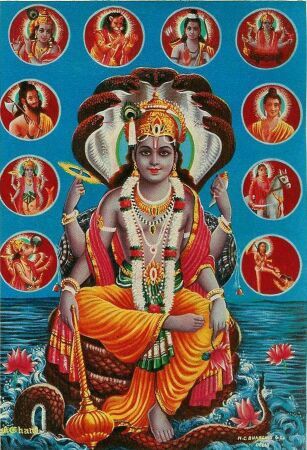
VISHNU - HINDU GOD OF PRESERVATION

.
.
Vishnu represents that aspect of the divine reality
that maintains and sustains the creation. The endless creative force of Brahma gives life to all beings, and Vishnu's infinite sustaining force protects this life.

Just as the feminine Supreme Energy,
Vishnu has a "thousands names" which symbolize in fact just as many of his aspects. The daily repetition of Vishnu's thousand names is a living proof of his devotee's faith and ardor.

Vishnu's blue body is often depicted in blue.
The color blue symbolizes the infinite. Vishnu is represented as an infinite force. He has no form, no name, and he is incommensurable.

The garland of flowers around Vishnu's neck is a
symbol of God's worship. The precious stone decorating his neck indicates that Vishnu fulfills his worshiper's desires and the crown is a symbol of the Divine's power and supreme authority. His two earrings stand for the dual nature of creation.

Vishnu wears yellow clothing.
The yellow color is associated with the terrestrial life. The dress of Vishnu, therefore, symbolizes his incarnations as a man, fighting for justice and destruction of the evil.
.
.
"Vishnu, the Preserver, sustains the whole creation
and has the power of manifesting himself under
numerous forms. In the great Cosmic Ocean,
He sustains both the sun of the infinite and
the eternal spirit of existence, which is the
master of the universe."
Vishnu Purana

Vishnu the Preserver, is often depicted
as lying on Ananta, a many-headed serpent.
He lives on Meru with his wife Lakshmi.
Vishnu usually rides through the heavens
on Garuda, a man-bird, endowed with
highly unusual powers, which spreads
courage and Vedic knowledge.
. 
His first incarnation was a fish,Matsya;
the second a turtle, Kurma; the third a wild boar, Varaha;
 the fourth a lion; the fifth a dwarf, Vamana;
 the sixth a warrior, Parasurama; the seventh a hero, Rama;
 the eighth Krishna; the ninth Buddhah.
.
.
Very often, Vishnu appears under the form
of a young, very handsome man, with four arms
(several arms is an indication of the divine,
showing that they can perform several
functions in the same time).

In his hands, Vishnu is shown holding
a shell, a disk, a lotus, and a scepter.
The symbolism of the shell is two-folded:
on one hand it represents Vishnu's relationship
with the primordial waters and its use
as a musical instrument, reminiscent of the
primordial waters, and on the other hand
the shell represents the five elements,
and consequently the origin of manifestation.

The lotus is a symbol of the spiritual
development and cosmic harmony.
It also signifies the appearance of life on
the neutral immensity of the primordial waters.

The opening of the lotus bud represents
the realization of the possibilities contained
in the "seed" of the human being.
The scepter is a symbol of power and authority.

The disk is a solar symbol,
and the classical image of Vishnu, the ascendant,
unifying, intellectual tendency of a human being.
It represents the power that destroys the
ignorance and the darkness, just as it is a symbol
of a killing weapon, and of the sun. It destroys
the evil through the process of illumination.

Vishnu is more a god of love.
For a Vaishnavite, salvation is usually won
by bhakti, a loving devotion to God as preserver.
Vishnu is considered the guardian of mankind
and the keeper of the Dharma.
He preserves the order in the universe.
Every time the humanity decays, Vishnu takes on
the form of an avatar, a divine model coming
on earth, to show people new paths for spiritual
development. He has taken nine incarnations.
.
.
Vishnu's tenth incarnation, Kalki,is supposed to come about
 at the end of this age, Kali Yuga. He is said to be
the cosmic rider of Apocalypse, who will take on the role of
 destroyer of what is evil on earth.
.
The most important incarnations of Vishnu are Rama and Krishna.
To Hindus, Rama, who is nearly always noble and righteous, is the ideal man. Sita, incarnation of Lakshmi and his loyal wife, is the ideal woman. All sects reverence Rama. No name is more commonly given to Hindu children, and all Hindus would like to die with his name on their lips. When Mahatma Gandhi fell, mortally wounded by a fanatic assassin, he murmured "Ai Ram, Ai Ram" (O Rama, O Rama).

Krishna, even more popular and lovable, is the subject of countless stories and legends. As a youth Krishna flirts with the Gopi milk maidens and has an affair with one, Radha. These erotic experiences are interpreted symbolically. Individual souls are drawn to God as the milkmaidens were attracted to Krishna, and one should give one's self to God in complete surrender as Radha did to Krishna.
.
 From the Hinduism Infocenter at 1stHolistic.com.

 .