Translate

Showing posts with label missionaries. Show all posts

Saturday, September 10, 2011

TURNING THE POLYNESIANS INTO GOOD CHRISTIANS

.
.
The music in the video below is an OK background for the text.
.
 .
Edited from THE MISSIONARIES
by Norman Lewis
.
In 1767 the English navigator Wallis discovered
 the island of Tahiti.  His visit was rapidly followed by those of the French explorer de Bougainville, and Captain James Cook.  Between them these men opened up the Pacific.  All three captains were overwhelmed by their reception at the hands of the people of Tahiti, and by the gifts showered upon them.
.
.
  When Cook left Tahiti at the end of his second mission he wrote in his journal,
'I directed my course to the West and we took our final leave of these happy islands and the good people on them.'  Some years later he was to write, 'It would have been far better for these poor people never to have known us.'
.
.
.
.
Captain Bligh of the Bounty - that stern judge of men - was if possible more impressed.  It had been noted back home that the physique of the people of Tahiti was somewhat superior to those of Europe, and the conjecture was that the breadfruit forming a large part of their diet might have contributed to this fact.  Bligh spent five months in Tahiti gathering shoots from the breadfruit tree for transportation to the West Indies in the hope of improving the condition of negro slaves.  In Tahiti he has become a kind of folk hero, and the memory of him was that he spent much of his spare time playing with the local children.  When he finally sailed he wrote: I'd left these happy islanders with much distress, for the utmost affection, regard and good fellowship was among us during our stay....their good sense and observations joined with the most engaging disposition in the world will ever make them beloved by all who become acquainted with them as friends.'  A few days later the famous mutiny on the Bounty took place, due to the determination of members of his crew not to return to England but to remain and settle on the islands where they had found so much happiness.
.
.
.
The accounts given by the great navigator, and by the lesser sailors and adventurers who followed them of the civilization of the South Seas produced a deep and even dangerous effect in Europe.  Certain thinkers, above all Jean-Jacques Rousseau, who wrote of the Noble Savage, seemed inclined to argue the opinion that man had not - as had been so commonly preached and accepted - been 'born in sin,' but in his primeval condition was naturally good, and that this original goodness had been concealed due to subjugation of corrupt societies.
.
.
A counter-attack by the religious orthodoxy of the day
was inevitable.  In 1795 the London Missionary Society was formed, its immediate attention focused upon the Pacific; two years later a convict ship bound for Australia put the first missionaries ashore on Tahiti.  They, too, were overwhelmed by the warmth of their welcome and since the Tahitians were clearly disposed to give things away they asked for the Bay of Matavai, where they had landed, to be given to them.  The request was instantly granted by the local chief, who had no conception of private property in land and was later disconcerted to learn that he and his people were to be debarred from the area.
.
.
The evangelists were a strange assortment, picked by the Society on the score of their probable usefulness to instructed savages, and they included a harness-maker, bricklayer, farmer, weaver, and a butcher and his wife.  None of them had ever left England before and few had left their native villages.  It was four years before any of them learned enough of the language to preach a sermon to a puzzled though sympathetic audience.  The Tahitians built their houses, fed them, and provided them with servants galore, but after seven years not one convert had been made.  Children called upon to line up and repeat over and over again this simple verse in Tahitian did so obligingly and with good grace.
.
No te iaha e ridi mei ei Jehove is oe?
For what is Jehova angry with thee?
No te taata ino wou no to'u hamini ino
Because I am evil and do evil.
.
But another seven years of such attempted indoctrination produced no results, then suddenly the great breakthrough took place.
.
.
The device which eventually established the unswerving missionary rule is described in a letter to home by one of the brethren, J.M. Orsmond.  'All the missionaries were at that time salting pork and distilling spirits....Pomare (the local chief) had a large share.  He was drunk when I arrived and I never saw him sober.'  Orsmond describes the compact by which Pomare, reduced to an alcoholic, would be backed in a war against the other island chiefs on the understanding that his victory would be followed by enforced conversion.  Since Pomare was supplied with firearms to be used against his opponents' clubs, victory was certain.  'The whole nation,' Orsmond wrote, 'was converted in a day.'
.
.
.
There followed a reign of terror.  Persistent unbelievers were put to death and a penal code was drawn up by the missionaries and enforced by missionary police in the uniforms of Bow Street Runners.  It was declared illegal to adorn oneself with flowers, to sing (other than hymns), to tattoo the body,
 to surf or to dance.
.
.
.
.
Minor offenders were put in the stocks, but what were seen as major infringements (dancing included) were punished by hard labour on the roads.  Within a quarter of a century the process by which the native culture of Tahiti had been extinguished was exported to every corner of the South Pacific, reducing the islanders to the level of the working class of Victorian England.
.
In time the population had been reduced by syphilis, tuberculosis, smallpox and influenza from the 200,000 estimated by Cook to 18,000.  After thirty years of missionary rule, only 6,000 remained.
.
Otto Von Kotzebue, leader of a Russian expedition into the Pacific in 1823, long before the decline had reached its terminal phase, wrote: 'A religion which forbids every innocent pleasure and cramps or annihilates every mental power is a libel on the divine founder of Christianity.'   The Tahitians, he said, were by nature ' gentle, benevolent, open, gay, peaceful and wholly devoid of envy; they rejoiced in each other's good fortune, and when one received a present, all seemed to be equally gratified.'  It grieved him that 'every pleasure should be punished as a sin among a people whom Nature destined to the most cheerful enjoyment.'
.
.
.

Saturday, February 26, 2011

HOPI KACHINAS

.
.
 .

.
Kachinas are supernatural beings,
who during periods when their dances are held,
are believed to visit the Hopi.
When this season is over,
they withdraw to their homes in the
San Francisco Mountains or elsewhere.
.
.
.
.
They are represented in the dances
by men who are masked and painted to
correspond to the traditional conception of
the appearance of each Kachina.

.
.
Small wooden images, carved, painted,
and decorated with feathers, are also used
to represent them.
After the ceremonial dances are held
these dolls are given to the children
to play with.
.
From a Santa Fe Railway brochure, 1948
.
.
.
.
.
.
.
From the Introduction to Masked Gods by
 Frank Waters
.
They began dancing.
Shaking their rattles at the cringing children.
Glaring at the stolid missionary.
Crying at the pipe-chewing trader.
Dancing back and forth before the rapt boy
seeing them for the first time.
No longer man nor beast nor bird,
but embodied forces of earth and sky
swirling across the sea of snow from the
blue montains on the horizon,
shaking this remote and rocky island,
stiring awake the archaic wonder and
mystery and pristine purity of man's
apperception of his cosmic role.
Dancing as gods have always danced before
their people. Masked by the grotesque,
but commanding that comprehension of the heart
which alone recognizes the beauty within. .

Suddenly it was over.
"Humph!" muttered Bruce, the trader. "Let's go."
The boy silently followed him down the trail
to the wagon. The missionary mounted his grey nag.
They plodded homeward to the trading post
and Bruce put on a pot of coffee.
The missionary stood in front of a shelf
looking at a row of small figures carved out of
cottonwood and painted to resemble the dancers.
"Idols," he said disapprovingly, new to the country.
"Dolls!" muttered Bruce tersely
.

.
.
The boy still held his tongue.
This was the first time he had
ever seen a kachina dance, and it still
held him in a strange spell he
could not shake off.
"You say these carved wooden idols
or dolls are called kachina,"
persisted the missionary.
"But you called those masked dancers kachinas too.
Now I can understand that all these images
represent a pagan anthropomorphic
god called Kachina.
But when an ethnologist tells me
the spirits of the dead, of mountains, clouds,
trees, and animals are all kachina,
I'm confused. I simply don't understand."
"Why the the hell should you?"
demanded Bruce, gruffly.
I don't know anything about Indians,
even after forty years."
.
The remarks about the kachinas
were confusing to the boy.
It did not matter. For, as years of comprehension
slowly crept upon him, he began to understand.
Life is a mystery play. It's players are cosmic principles
wearing the mortal masks of mountain and man.
We have only to lift the masks which cloak us
to find at last the immortal gods who
walk in our image across the stage.
.
. .
. 

.

Sunday, February 6, 2011

THE PROBLEM WITH MISSIONARIES

.
.
.

 
.
.
.
It is no accident that the world's
two largest and most widespread religions
include a missionary imperative.
Unlike faithful Hindus, Jews, Taoists,
and practitioners of Shinto, Christians and
Muslims are expected to carry the Good News
and the Islamic call to faith, respectively,
to the far corners of the world. Although they
disagree on the precise nature of God's revelation
and the paths to the ultimate goal, adherents in
both traditions agree that their faith incorporates
a missionary mandate. Far too often in both
traditions, however, a narrow understanding of
mission has combined with cultural imperialism
and military power in ways that destroyed any
witness to God's love and mercy.
.
.Examples of missionary-related abuses abound.
The history of the spread of Christianity and Islam
in Europe, Asia, Africa, and the Americas (for
Christianity) is a checkered one at best.
Pick a continent and study the behavior of
those who came in the name of these religions.
Raw power and conquest sometimes dominated
the process. Conversion by force is often inter-
twined with moving stories of people whose faith
and courage changed them and their communities
in many positive ways. Certain missionaries made
life-changing contributions, making possible
greater opportunities in health care, education,
and the economy, but celebrating the positive
doesn't tell the whole story. When missionary
zeal is informed by absolute truth claims
defining who is "saved" and what is acceptable,
the propagation of religion frequently
includes sinister dimensions.
.
.
.
.
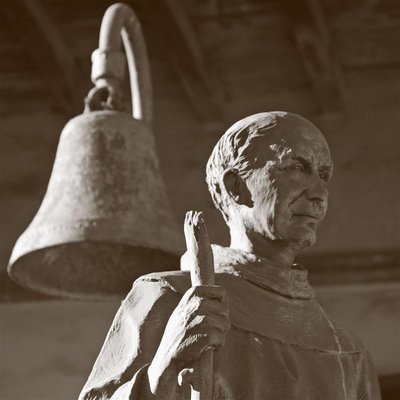
The California missions system (1769-1834)
as founded and developed by Father Juipero
Serra exemplifies the problem. Serra's piety,
courage, and commitment to evangelize
Native Americans have been affirmed by
his critics as well as by those who advocated
for his beatification in 1988 (a formal step
toward canonization as a saint in the Roman
Catholic tradition). A professor of theology,
Serra left Spain for the mission field of the
new world in 1749. By the time of his death
in 1782, he had walked some twenty-four
thousand miles through Mexico and California
and established twenty-one Franciscan missions.
However noble his intentions, his methods and
close cooperation with Spanish government
and military officials were cruelly devastating
to the indigenous people. The mission was,
in fact, part of a larger strategy of colonization
and conquest. Serra and his fellow missionaries
traveled to new territory with Spanish military
contingents and apparently understood
themselves as agents of both God
and the civil government.
.

.
Serra and others like him viewed the
native population as savage heathens
who had to be disciplined as children.
Their version of discipline would warrant
state intervention and charges of child
abuse in California today. The Franciscans
were convinced that cultural conversion was
a prerequisite to conversion to Christianity.
With righteous determination, "they went
about the task of dismantling what they
regarded as backward traditional lifeways,
social structures, mores, and values of
Indian peoples." Missionaries destroyed
towns, separated families, instituted slavery
and economic exploitation, applied religious
coercion ruthlessly, and carried out various
types of corporal punishment.
.
 George Tinker, a Native American seminary
 professor and pastor to Lutherans and Episcopalians
 in Denver, closely examines Serra and three
other highly respected historical missionary
leaders and concludes that they were naive
and possibly unwitting partners in genocide.
Without question, the California mission is
part of a larger pattern beginning with the
subjugation of Aztecs and other native peoples
in Mexico. Franciscans, Augustinians, and
Dominicans carried the enterprise north
into Texas, New Mexico, Arizona, and
California.
.
.
.
The uncritical mixing of religious, political,
military, and economic realms in the missionary
conquests of the Southwest offends contemporary
sensitivities and contradicts the cherished
principle of the separation of church and
state. It is far closer to the military, political,
and religious expansion of Islam in the seventh
and eighth centuries. These and missionary
movements in Asia and Africa reflect another
era and outdated worldviews. In different
ways at different times, Christian and Muslim
missions rested on absolute truth claims -
stated or assumed - that theirs was a superior
culture and religion. In fairness to early
Islamic expansion - across North Africa and
into Spain, through the Fertile Crescent and
across Mesopotamia and Persia into India -
there is little evidence of widespread conversion
at the point of a sword.
*
From WHEN RELIGION BECOMES EVIL
by Charles Kimball
.
.
.
.

.

.